

Duffel vs Backpack for Your Personal Item: Which Bag Is Easier to Fly With?
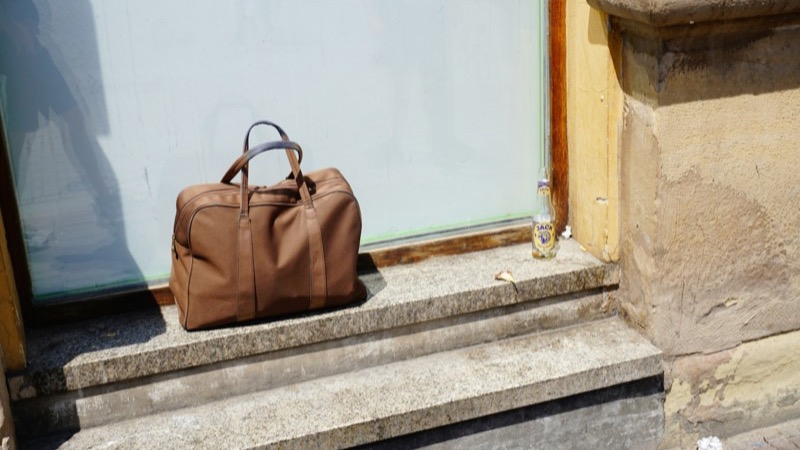
Both a small duffel and a backpack can be your personal item, as long as the bag fits under the seat in front of you. The real difference is how they carry and how they pack. A backpack is easier on your body when you walk a long way. A duffel is easier to pack and to reach into at your seat. If you also roll a suitcase, a duffel with a luggage sleeve gives you the best of both.
A backpack wins when you walk a long way
A backpack spreads the weight over both shoulders and your back. That matters on long walks: a big airport, a train station, cobblestones from the bus stop to your hotel. You keep both hands free the whole time.
A duffel or tote hangs from one shoulder or one hand. With a laptop and two days of clothes inside, that one shoulder carries everything, and travelers often say it starts to ache well before the gate. A wide, padded strap helps, but it doesn't change the basic problem.
So if you travel with only a personal item, and you walk a lot, a backpack is the easier bag. Our personal item backpack comparison covers bags built for that.
A duffel wins at your seat
Under the seat, a backpack usually lies on its back or its side. To reach anything, you pull it out, turn it over and unzip it in your lap. Unless it has a good outside pocket, getting headphones out is a whole job.
A duffel or tote sits upright with its opening on top. You unzip it where it is and reach in. That sounds small, but on a long flight you go into your bag again and again: snacks, a charger, a sweater, your passport before landing.
A duffel packs more like a suitcase
Most backpacks load from the top or open partway down the front, so things pile up from the bottom. A duffel is wide and flat, so clothes lie in layers, and you can see most of what's inside when you open it.
Some duffels go further. The Nomad Lane Bento Bag, our top pick, opens down the middle into two separate sections, like a small suitcase. Clothes go on one side and shoes and gear on the other.
The luggage sleeve changes everything
The biggest downside of a duffel is carrying it. A luggage sleeve fixes that. It's a band of fabric on the back of the bag that slides over the handle of your rolling suitcase. The duffel then rides on top of your roller, and you push both with one hand.
That's why a duffel makes the most sense when you also bring a carry-on suitcase. Four of the five bags we compared have a sleeve, and the fifth is made to sit on top of a roller bag instead.
Without a suitcase, a sleeve doesn't help, and you're back to one shoulder.
Size works the same way for both
Airlines measure the bag, not its shape. Many use about 18 x 14 x 8 inches for a personal item, but some are smaller. Soft duffels and backpacks both bulge when you overpack them, and a stuffed front pocket is the usual way people go over.
A duffel has one small advantage here: it squashes down from the top, so a full one can still slide under a seat. A backpack with a stiff back panel can't do that.
For each airline's numbers, see our personal item size by airline guide.
Pick a duffel if you roll a suitcase, a backpack if you don't
- Choose a duffel or tote if you fly with a rolling suitcase too, you want to reach into your bag at your seat, or you pack clothes and want them to stay flat.
- Choose a backpack if the personal item is your only bag, you walk a lot on the trip, or you have sore shoulders.
- If you choose a duffel, get one with a luggage sleeve, a shoulder strap and a laptop sleeve, so the laptop isn't loose at the bottom.
For five under-seat duffels and totes compared on those features, see our best personal item bags for travel.